Blog

Management Careers: Your Roadmap From Team Lead to Senior Leadership Maria started her working life stacking shelves at a regional supermarket. She wasn't the loudest person on the team and she certainly didn't have a business degree. What she did have was a habit of noticing problems and quietly fixing them. Within two years she was a shift lead, within five she was running a department, and today she oversees operations across several locations. Her story isn't a miracle. It's what a well-planned management career can look like when curiosity meets opportunity. If you're wondering whether a long-term career in management is realistic for you, this roadmap is designed to make it feel concrete. We'll walk through each stage from first supervisory role to executive leadership, the skills that matter at every level, how to handle setbacks, and how to use job search tools so that each step forward is deliberate rather than accidental. Understanding the Management Career Ladder Management careers rarely follow a perfectly straight line, but most share a recognisable structure. Seeing it laid out helps you decide where you are and where you'd like to go. Stage 1: Supervisor or Team Leader This is where most careers begin. You guide a small group, handle daily scheduling and act as the first point of contact for problems. It's a practical introduction to responsibility, and for many people it's the moment they discover they genuinely enjoy leading. What Success Looks Like at This Stage Your team trusts you and comes to you with issues early You meet daily targets consistently You communicate clearly with both your team and your own manager Stage 2: Assistant Manager or Department Manager Here you take on wider responsibility, such as budgets, hiring input and performance reviews. You begin shifting from doing the work to enabling others to do it well. Stage 3: Manager or Operations Manager At this level you own results. You set priorities, manage multiple teams or functions and report to senior leaders. Strategic thinking starts to matter as much as day-to-day execution. Stage 4: Senior Manager or Director Directors manage managers. You shape strategy, guide budgets across departments and influence company culture. Your time shifts from fixing problems to preventing them. Stage 5: Executive Leadership Vice presidents and chief officers set the long-term direction. By now your impact is measured in organisational performance, not just team outcomes. Choosing Your Management Specialism The beauty of management careers is that you can lead in almost any field. Choosing a lane early helps you build focused expertise, though you can always pivot later. Operations and Supply Chain If you love efficiency, logistics and systems, this lane rewards you for making complex processes run smoothly. Explore current Supply Chain jobs to see where operational leaders are in demand. Finance and Accounting Leadership Numbers-driven leaders move from analysts to finance managers and eventually to controllers or finance directors. Start by reviewing Accounting jobs to understand the career steps. Marketing and Commercial Leadership Creative and analytical thinkers can progress from campaign coordinators to marketing managers and heads of marketing. Browse Marketing jobs to see how responsibilities grow with seniority. Engineering and Technical Management Technical experts often become team leads or project managers. If this is your path, the Engineering jobs category shows roles where technical skill and leadership meet. Technology and IT Leadership Developers and analysts can step into team lead, project manager and IT manager roles. Take a look at I.T. & Communications jobs for current openings. Property and Construction Management Site supervisors, project managers and property managers build careers around real-world assets. Check Construction jobs and Property jobs to compare opportunities. Skills That Carry You Through Every Stage Some skills matter at every level, though the way you use them changes as you rise. Communication At first it means giving clear instructions. Later it means explaining strategy to executives and inspiring teams you may never meet in person. Decision-Making Early decisions are operational: who covers the shift, which task comes first. Later decisions affect budgets, hiring plans and long-term direction. Emotional Intelligence Understanding people's motivations, stress points and strengths becomes more valuable the more people you lead. Strategic Thinking As you progress, you spend less time on today's tasks and more on questions like "Where should this department be in three years?" How to Build Strategic Thinking Early Ask your manager why decisions are made, not just what they are Read about your industry's trends Volunteer for projects that cross departments Learn how your team's work connects to company profit Continuous Learning The American Management Association offers seminars and courses on leadership, communication and management skills, which can help you stay current as responsibilities increase. How to Move Up: Practical Strategies That Work Promotion rarely happens by accident. Here's how to be intentional. Make Your Results Visible Keep a simple record of your wins: targets hit, problems solved, people developed. When review time arrives, you'll have evidence rather than vague impressions. Find a Mentor A mentor who has already walked your path can shorten your learning curve dramatically. Look for someone one or two levels above you who is willing to share honest advice. Ask for Stretch Assignments Volunteer for tasks slightly beyond your comfort zone, such as leading a small project, covering a manager's meeting or onboarding new hires. These show initiative and let you practise skills before you need them. Build Relationships Across the Business People outside your team notice what you do. Strong relationships across departments make you a natural candidate when new roles open. Education, Certifications and Training There's no single route into senior leadership, and that's good news. When a Degree Helps Degrees in business, finance, engineering or healthcare administration can support progression in structured industries. They're not always mandatory, but they can speed up certain paths. Certifications Worth Considering Project management credentials Lean or process improvement training HR and people management certificates Industry-specific safety or compliance qualifications Learning on the Job Many leaders credit practical experience as their greatest teacher. Combine it with short courses and reading, and you can build a strong foundation without pausing your career. Management Careers in Small Businesses and Startups Large corporations aren't the only route. Smaller organisations often give you broader responsibility sooner, though with fewer formal structures. Advantages of Smaller Employers Faster promotion when the business grows Exposure to several functions at once Closer contact with senior decision-makers Resources for Aspiring Business Leaders If you eventually dream of running your own company, the U.S. Small Business Administration provides guidance on planning, funding and growing a business, which pairs nicely with years of management experience. Handling Setbacks Along the Way Every career has detours, including missed promotions, difficult bosses and restructures. What matters is how you respond. When You Get Passed Over for Promotion Ask for specific feedback, build a development plan and set a clear timeline for reassessment. Sometimes the best next step is a role at another company. When You Feel Burned Out Management brings pressure. Protect your time, delegate effectively and take real breaks. Strong leaders know that rested teams perform better. When You Need a Fresh Start Changing industries is common, and your leadership skills transfer more readily than you might expect. Thoughtful research, networking and a tailored CV can make the switch smoother. Using Job Search Tools to Plan Your Next Move Smart job searching isn't only for when you're unemployed. Reviewing openings regularly shows you what employers value, what titles are trending and what skills you may need. Practical Steps Browse the Management jobs category to compare requirements for roles one level above yours Note the skills that appear repeatedly and build them deliberately Keep your profile current by choosing to create a resume so employers can find you Set alerts for target job titles so you can act quickly Reading Leadership Insight For deeper thinking about leading people and organisations, Harvard Business Review publishes research-backed articles that can sharpen your approach at every career stage. Ready to Build Your Management Career? A fulfilling management career doesn't require a perfect plan. It requires curiosity, consistency and the courage to keep stepping up. Start where you are, learn from every role and keep your eyes open for the next opportunity. Take the first step today by exploring open roles on the Search Jobs page, and let us know in the comments: which stage of the management ladder are you on right now? If this roadmap helped, share it with a colleague who's ready to lead. Frequently Asked Questions 1. What does a typical management career path look like? Most people progress from supervisor or team leader to assistant manager, manager, senior manager or director, and eventually executive leadership. The exact titles and timelines vary by industry and company size. 2. How long does it take to build a successful management career? It depends on your goals and performance, but many professionals reach manager level within several years of consistent results and learning. Senior leadership typically takes longer and often involves broader strategic experience. 3. Which skills are most important for long-term management careers? Communication, decision-making, emotional intelligence, strategic thinking and a commitment to continuous learning are valuable at every stage. The way you apply them evolves as your responsibilities grow. 4. Can I switch industries and still pursue a management career? Yes. Leadership skills such as planning, coaching and problem-solving transfer across sectors. Highlight those strengths and learn the basics of your new industry to make the transition smoother. 5. Where can I find management career opportunities? Browse the management and related industry categories on My Jobs Near Me, filter by your location and set alerts to be notified when new roles are posted. //

Entry-Level Management Jobs: How to Land Your First Leadership Role With Little Experience "You need experience to get a management job, and you need a management job to get experience." If that sentence has ever made you want to close your laptop and walk away, take a breath. It's one of the most repeated myths in career advice, and it simply isn't the full story. Thousands of people step into their first leadership role every year without a decade of seniority, and most of them did it by understanding what employers are really hiring for. This guide is written for the ambitious newcomer: the retail associate who keeps getting asked to train new staff, the recent graduate who wants more than an administrative role, the career-changer who has led informally for years but never held the title. We'll cover which entry-level management jobs exist, what hiring managers want to see, how to translate everyday experience into leadership credentials, and how to build a plan that gets you from applicant to supervisor. What Counts as an Entry-Level Management Job? Let's start with a clear definition, because it saves a lot of confusion. An entry-level management job is a role where you take responsibility for guiding people or processes, but with limited prior experience required and plenty of support from more senior leaders. Common Titles You'll See in Listings Management Trainee Assistant Manager Shift Supervisor Team Leader Department Lead Junior Project Coordinator Assistant Store or Branch Manager Why the Titles Vary So Much Companies use different language for similar work. A "team leader" in a call centre may do almost exactly what a "shift supervisor" does in a warehouse. Searching with several variations ensures you don't miss roles that fit you perfectly. What These Roles Usually Involve Expect a blend of hands-on work and early leadership tasks: scheduling team members, handling customer escalations, tracking daily targets, coaching newer colleagues and reporting to a senior manager. It's a practical training ground for bigger responsibilities later. Why Entry-Level Management Jobs Are Worth Pursuing It's easy to assume you should wait until you feel "ready." The truth is that nobody feels completely ready, and starting sooner gives you a head start that compounds over time. Faster Skill Growth Leading even a small team teaches you more about communication, prioritisation and conflict resolution in six months than a classroom can in a year. Stronger Earning Potential Management positions generally pay more than the individual contributor roles beneath them, and early leadership experience opens doors to higher-paying jobs later. A Clearer Career Ladder Many employers prefer promoting trusted team members to hiring outsiders. Starting in a junior leadership position can place you directly on a visible path to senior roles. Skills You Probably Already Have (and How to Prove Them) Here's where many applicants undersell themselves. Leadership isn't something that only appears after a promotion; you've likely been practicing it already. Everyday Experiences That Count as Leadership Training or onboarding a new colleague Covering a shift or reorganising a rota Organising a school, community or volunteer project Handling a difficult customer and resolving the issue Captaining a sports team or leading a club Turning Experience Into CV Language Instead of writing "helped new staff," write "Trained five new team members over six months, reducing onboarding time by one week." Numbers, even approximate ones, make your contribution concrete. Core Skills Hiring Managers Look For Communication – speaking clearly and listening patiently Reliability – turning up, following through and owning mistakes Problem-solving – staying calm and finding workable fixes Teamwork – supporting colleagues rather than competing with them Willingness to learn – asking questions and accepting feedback Skills Worth Building Right Now If you want to strengthen your profile, consider short courses in project basics, time management or workplace communication. The Project Management Institute offers resources and entry-level credentials that signal commitment to employers who value structured delivery. Where to Look for Entry-Level Management Jobs Knowing where to search matters as much as knowing what to say. Spread your efforts across a few focused areas. Start With the Right Category The Entry Level jobs section is an ideal starting point, and pairing it with the Management jobs category helps you spot positions that welcome developing leaders. Explore Adjacent Fields Some of the best first leadership roles sit in industries you might not have considered: Administration jobs often lead into office or operations supervision Business Development jobs can grow into account or team management Training jobs build the coaching skills every manager needs Call Centre and Customer Service jobs are famous for promoting reliable agents into team leader positions Consider Apprenticeships and Training Programs Structured programs let you earn while you learn. The Apprenticeship.gov website lists registered programs across industries, including leadership and business-focused pathways. Building a CV That Gets Noticed for Entry-Level Management Roles Your CV has roughly seconds to convince a recruiter that you deserve a closer look, so every line needs a purpose. Structure It Simply Name and contact details A short summary highlighting leadership potential Key skills Work experience with achievements Education and certifications Write a Summary That Shows Direction Try something like: "Reliable customer service professional with two years of experience training colleagues and resolving escalations, seeking a team leader role to develop management skills." It's short, honest and clearly aimed. Add Keywords From the Listing Many employers use screening software. Mirror words like "scheduling," "coaching," "team performance" and "customer satisfaction" when they genuinely describe your work. When your CV is ready, register your CV so employers searching for new talent can discover you directly. Nailing the Interview for Your First Management Job Interviewers know you're new to the title. What they're really testing is your potential. Questions You Should Prepare For "Tell me about a time you led others, formally or informally." "How would you handle a team member who is consistently late?" "What would you do if two colleagues refused to work together?" "Why do you want to move into management?" A Simple Answer Framework Describe the situation, explain what you did, and share the result. Keep each story under two minutes, and choose examples that show calm, fairness and accountability. Questions You Should Ask Ask about training, team size, expectations for the first ninety days and how success is measured. These questions show maturity and genuine interest, which are valuable qualities in a future manager. Avoiding Common First-Time Manager Mistakes Getting the job is step one. Doing it well is step two. Mistakes to Watch For Trying to be everyone's friend instead of a fair leader Taking on every task personally instead of delegating Avoiding hard conversations until problems grow Neglecting to ask for feedback from your own manager How to Build Credibility Quickly Listen first, learn how the team works, keep promises and admit when you don't know something. Respect grows when people see consistency over time. The Society for Human Resource Management publishes practical articles and toolkits on coaching, communication and workplace conflict, which are excellent resources for anyone stepping into supervision for the first time. Mapping Your First Year as a New Manager Think of your first year in three simple phases. Months 1 to 3: Learn Understand your team's strengths, the company's systems and your manager's expectations. Take notes and ask plenty of questions. Months 4 to 8: Improve Identify one or two small process improvements. Success in a visible area builds trust with both your team and senior leaders. Months 9 to 12: Grow Request feedback, discuss development goals and explore training that prepares you for the next level. Ready to Take Your First Step Into Management? Entry-level management jobs exist because companies need fresh leaders who are eager to learn. You don't have to be perfect, you just have to be prepared, willing and able to show how your existing experience translates into leadership. Browse the latest openings on the Search Jobs page, tailor your CV to the roles that excite you, and apply this week. Tell us in the comments: what leadership experience do you already have that you've never put on your CV? You might be surprised how much you've already done. Frequently Asked Questions 1. What are the best entry-level management jobs for beginners? Shift supervisor, team leader, assistant manager and management trainee are popular starting points. They combine hands-on work with early leadership duties and usually include on-the-job training. 2. Can I get a management job without prior management experience? Yes. Employers often accept informal leadership, such as training colleagues, organising projects or covering shifts, as evidence of potential. Presenting those examples clearly on your CV makes a big difference. 3. Do entry-level management jobs require a degree? Not always. Many supervisory and trainee roles prioritise reliability, communication and customer or team experience over formal qualifications, although some industries do prefer a degree or certification. 4. How long does it take to move from entry-level to senior management? It varies by industry and performance, but many people progress through supervisory and assistant manager roles over several years. Seeking training, mentoring and measurable results can speed up the journey. 5. How can I find entry-level management jobs near me? Use the entry-level and management categories on My Jobs Near Me, filter by city or state, and set job alerts so you can apply as soon as new roles are posted.
Management Jobs Near Me: How to Find Local Openings Before Everyone Else Does Have you ever searched "management jobs near me," scrolled for twenty minutes, and ended up with a headache and three browser tabs you can't remember opening? You're in good company. Local job hunting sounds simple: type, click, apply. In reality, it's a mix of outdated listings, roles that are "near" you only if you're willing to commute two hours, and postings that vanish the moment you finally find one that fits. The good news is that finding genuinely local management work is a skill you can learn. This guide walks you through exactly how to search with precision, where the best local opportunities hide, how to spot suspicious listings, and how to stand out once you've found the right opening. No fluff, just practical steps you can use today. Why Searching for Management Jobs Near Me Works Better Than a General Search When you search broadly, you compete with candidates from every corner of the country. When you search locally, you compete with a smaller pool, and you gain advantages that national applicants simply don't have. The Hidden Benefits of Going Local Shorter commutes – which means better work-life balance and lower daily costs Faster hiring – local employers often interview in person within days Community knowledge – you already understand the area, its customers and its challenges Stronger networks – local contacts can refer you internally What "Near Me" Really Means for Managers For managers, proximity matters more than for many other roles. You're expected to be available in emergencies, attend early meetings and sometimes cover odd hours. Employers know this, and they often favour candidates who live within a comfortable distance. Local Doesn't Mean Limited Many cities have thriving management markets in healthcare, logistics, retail, construction and financial services. Even mid-sized towns have regional offices and distribution hubs that quietly hire managers all year. Step-by-Step: How to Find Management Jobs Near You Let's get practical. Follow this simple process and you'll go from scrolling aimlessly to applying confidently. Step 1: Start With a Dedicated Management Category Instead of searching the entire job market, begin with the Management jobs category on My Jobs Near Me. It collects hundreds of management openings in one tidy place, which saves you from sorting through unrelated listings. Step 2: Narrow by City or State Once you've seen what's available, switch to your location. Popular hiring hubs include Jobs in New York , Jobs in Dallas and Jobs in Phoenix , each with hundreds of active listings. Living elsewhere? Browse by state, such as Jobs in Ohio or Jobs in Florida . Tips for Choosing Your Search Radius Start within a distance you'd genuinely commute daily Expand gradually if results are thin Consider hybrid roles that reduce your travel days Look at neighbouring cities, since employers often sit just outside city limits Step 3: Use Smart Job Title Variations Employers don't all use the same title for the same job. If "Operations Manager" brings few results, try these alternatives: General Manager Assistant Manager Department Supervisor Branch Manager Team Lead Shift Manager Step 4: Read the Whole Listing, Not Just the Title A "manager" title can hide very different expectations. Check for team size, reporting lines, hours, on-call duties and required certifications before you invest time in applying. Industries Hiring Local Managers Right Now Different sectors have different rhythms. Understanding them helps you target the right employers at the right time. Healthcare and Facilities Hospitals, clinics and care facilities constantly need department managers, supervisors and facility coordinators. If you enjoy purposeful work, explore the Healthcare & Medical jobs category for leadership-track openings. Logistics, Warehousing and Supply Chain Distribution centres run around the clock and need managers who can keep orders moving. Browse Supply Chain jobs and Warehouse jobs to compare roles and shift patterns. Retail, Hospitality and Franchise These industries promote from within frequently. You can start as a team member and step into assistant manager within a year or two. Check Franchise jobs for local business-ownership-style management opportunities. Construction and Property Site managers, project coordinators and property managers are in steady demand. Local knowledge, such as permits, suppliers and neighbourhoods, gives you a real edge here. How to Spot Fake or Low-Quality Management Job Listings Unfortunately, job seekers sometimes encounter listings that look appealing but aren't genuine. A little caution protects your time, money and personal information. Warning Signs to Watch For Pay that seems far too high for the described duties Requests for payment, equipment fees or bank details before an interview Vague company names with no website or contact details Pressure to accept an offer immediately Interviews conducted entirely through messaging apps The Federal Trade Commission publishes clear advice on recognising job scams, and it's worth a quick read before you share any sensitive details with an employer. Simple Verification Habits Check the Company Search the employer's name, look for a real website and confirm that the location exists. Check the Process Legitimate employers don't ask you to pay to be hired. If something feels off, trust your instincts and walk away. Making Your Application Impossible to Ignore Locals have an advantage, but only if your application actually lands well. Here's how to tilt things in your favour. Tailor Your CV to Each Posting Mirror the language in the job description. If a listing asks for "scheduling and workforce planning," make sure those exact phrases appear in your experience section, backed by a real example. Mention Your Local Connection A short line such as "Based in the Dallas area with strong knowledge of regional suppliers" signals reliability and reduces an employer's worry about relocation or long notice periods. Prepare for Local Interview Questions Expect questions about availability, flexibility and community knowledge. Have a story ready that shows you can keep a team motivated through a busy period. When you're ready, create your resume on the platform so employers can find you directly and you can apply to multiple roles without retyping everything. Using Job Alerts and Timing to Get Ahead Speed matters. Many management jobs near you attract the most applications in the first few days. Best Practices for Job Alerts Set alerts for two or three job title variations Choose daily emails during an active search Review new listings the same day they arrive Apply within 48 hours whenever possible Timing Your Search Hiring tends to pick up at the start of the year, after the summer slowdown and ahead of peak seasons in retail and logistics. Keep applying outside those windows too, because managers leave and positions open up all year. Researching Local Pay and Employer Demand Before you accept any offer, compare it to what similar roles pay in your region. Salaries differ between a major city and a small town, and a good offer in one place can be below average in another. Where to Find Reliable Local Data The U.S. Census Bureau provides regional population and business data that can help you understand which areas are growing and where employers are likely to expand. Pair that with live listings and you get a clear picture of where management demand is strongest. Looking Beyond the Private Sector Government roles also include management tracks, from program supervisors to department heads. Federal openings are posted on USAJOBS , which is useful if you're comfortable with a more structured application process. Ready to Find Management Jobs Near You? Finding the right local management role doesn't need to feel like a lottery. Search the right category, narrow by location, verify each listing, tailor your CV and respond quickly. Do those five things consistently, and you'll move ahead of most applicants. Start by exploring the full jobs near me listings, set up your alerts and apply to your first role today. Got a tip for finding great local roles? Drop it in the comments, and share this guide with someone who's tired of endless scrolling. Frequently Asked Questions 1. How do I find management jobs near me quickly? Open the management category, filter by your city or state, and set up email alerts for new postings. Searching with a few title variations such as assistant manager or shift supervisor also widens your results. 2. Which industries offer the most local management jobs? Healthcare, logistics, retail, hospitality, construction and property management regularly hire local managers. Franchise businesses and regional offices also tend to recruit continuously. 3. How can I tell if a management job listing is a scam? Be wary of unusually high pay, requests for upfront payment, missing company details and pressure to accept immediately. Verify the employer online before sharing personal information. 4. Should I include my location on my CV? Yes, including your city or region helps local employers see that you can commute reliably. You do not need to include a full street address. 5. Can I find remote or hybrid management jobs near me? Yes. Many employers now offer hybrid or flexible management roles that still appear in local searches. Check each listing for the work arrangement before applying. //
Management Jobs: A Complete Guide to Finding the Right Role and Getting Hired Picture a Monday morning at a busy distribution centre. A delivery is late, two people have called in sick, and a customer is on hold asking where their order is. Somewhere in the middle of that chaos is one person who stays calm, reshuffles the schedule, makes a few quick calls, and has everything moving again within the hour. That person is a manager, and the ability to stay steady while everyone else is scrambling is exactly what employers across the United States are paying for right now. If you've been typing "management jobs" into a search bar and getting a wall of vague listings, this guide is for you. We'll break down what management work actually looks like day to day, which types of roles exist, what employers genuinely look for, how entry-level management jobs fit into the picture, and how to turn a casual search into a real interview. Grab a coffee, because this one is thorough. What Management Jobs Really Involve (Beyond the Job Title) "Manager" is one of the most stretched words in the job market. A manager at a five-person café and a manager at a national logistics company have very different days, yet they share the same core responsibility: getting good work done through other people. The Core Responsibilities Every Manager Shares No matter the industry, most management jobs revolve around five connected duties: Planning – setting goals, schedules and budgets so the team knows what "done" looks like Organising – assigning tasks and resources to the right people at the right time Leading – motivating the team, giving feedback and setting the tone for the workplace Problem-solving – handling the unexpected, from equipment failures to staff conflicts Reporting – keeping senior leaders informed with accurate numbers and honest updates A Quick Reality Check on the Daily Grind Management is rarely glamorous. Expect meetings, spreadsheets, difficult conversations and the occasional emergency at 5:55pm on a Friday. The reward is that you shape how a team performs, and that influence is something many people find far more satisfying than working alone. Management vs Leadership: Are They the Same Thing? Not quite. Management is about systems, processes and results. Leadership is about vision, trust and inspiring people. The best professionals blend both, and employers increasingly screen for both skills during interviews. The Main Types of Management Jobs You Can Apply For One reason management careers appeal to so many people is the sheer variety. You don't need to stay in a single lane, and many professionals move between these areas as they grow. Operations and Facilities Management Operations managers keep the lights on, literally and figuratively. They oversee production, logistics, maintenance and day-to-day workflows. If you like fixing processes and seeing visible results, browse the latest Facilities Management jobs to see what's hiring right now. Typical Job Titles in This Area Operations Manager Facilities Manager Warehouse Supervisor Plant Manager Sales and Marketing Management These roles combine people skills with commercial thinking. You might lead a sales team, manage a brand campaign or run a regional territory. Employers are always looking for leaders who can hit targets without burning out their teams, and you can explore current Sales & Marketing jobs to compare responsibilities and expectations. Human Resources and People Management HR managers handle hiring, training, workplace culture and compliance. It's a perfect fit if you're a natural listener and enjoy helping people grow. Take a look at open HR and Recruitment jobs if people-focused leadership appeals to you. Finance and Administrative Management Finance managers guard budgets and forecasts, while administrative managers keep offices running smoothly. Both are essential and tend to be steady, in-demand career paths. You can start by reviewing Finance jobs alongside general management listings. Project and Account Management Project managers deliver work on time and on budget. Account managers protect and grow client relationships. Both roles reward organisation, communication and a cool head under pressure, and they appear across nearly every industry from construction to technology. Skills Employers Look for in Management Jobs You can have a great CV and still stall at the interview stage if you can't show the right mix of skills. Here's what hiring teams consistently value. Hard Skills That Strengthen Your Application Budgeting and forecasting – even basic spreadsheet confidence helps Scheduling and workforce planning – especially in shift-based industries Software familiarity – project tools, HR systems, CRM platforms and the Microsoft Office suite Compliance awareness – safety, employment and industry regulations Soft Skills That Set You Apart Clear communication – explaining decisions simply and listening properly Emotional intelligence – reading the room and responding with empathy Decision-making – choosing quickly when information is incomplete Adaptability – staying useful when priorities change overnight To see how these skills are defined and rated for specific occupations, the O*NET OnLine database offers detailed breakdowns of tasks, knowledge areas and work styles for hundreds of management roles. How to Show These Skills Without Sounding Like a Template Hiring managers read hundreds of CVs that say "strong leader." Instead, show it. Write "Rescheduled a nine-person team around a staffing gap and kept deadlines on track" rather than "excellent problem solver." Specific examples are memorable, and they make your application feel real. Entry-Level Management Jobs: Starting Closer Than You Think Here's good news that surprises many job seekers: you rarely need to wait years before stepping into leadership. Plenty of employers hire for junior leadership positions, and they often promote from within. Roles to Search for If You're New to Management Shift Supervisor Team Leader Assistant Manager Management Trainee Department Lead Browsing the entry-level jobs category is a smart way to spot positions that offer growth into management without demanding a decade of experience. Experience You May Already Have You may be closer than you think. Have you trained a new colleague? Covered shifts? Organised a volunteer event or led a school project? These all count as leadership experience, and they belong on your CV. Where to Find Management Jobs and How to Search Smarter Searching with the right strategy saves hours. A scattergun approach, where you apply to everything and hear back from nothing, usually just drains your motivation. Use Targeted Searches Instead of Broad Ones Start with the dedicated Management jobs near me category, which gathers hundreds of live management openings in one place. From there, narrow by city or state so you only see roles you could realistically take. For example, you can open Jobs in Chicago or Jobs in Texas to focus on regions with high employer activity. Build a Profile That Employers Can Find Employers search for candidates too. When you register your CV , you let recruiters discover you, apply to roles faster and receive alerts when matching positions appear. Quick Profile Checklist Add a short professional summary focused on results List measurable achievements, not just duties Include relevant keywords such as "team leadership" and "operations" Keep contact details current Set Alerts So Opportunities Come to You Good management jobs often close quickly. Setting up daily or weekly job alerts means you can apply early, and early applications tend to get more attention than ones submitted on the final day. Salary and Growth: What to Expect From Management Careers Pay varies widely by industry, location and company size, so treat any single number with caution. What's consistent is that management roles generally pay more than the positions they oversee, and responsibilities tend to grow alongside the salary. Where to Check Reliable Pay and Outlook Data The Bureau of Labor Statistics Occupational Outlook Handbook publishes pay ranges, education requirements and job outlook for many management occupations, making it a trustworthy reference when you're comparing offers. Benefits Worth Asking About Health coverage and paid time off Retirement contributions such as a 401(k) match Training and tuition support Flexible or hybrid scheduling options Common Mistakes When Applying for Management Jobs Even strong candidates trip up in predictable ways. Mistakes on the Application Using one generic CV for every role Listing duties instead of results Ignoring the keywords in the job description Mistakes in the Interview Taking all the credit instead of acknowledging the team Struggling to describe a time you handled conflict Failing to ask thoughtful questions about team culture Practice a few stories using the situation, action and result format. Two minutes of clear storytelling beats ten minutes of vague answers. Planning Your Next Step Into Management Thinking about leadership is easy; moving toward it takes a plan. Start with one small step this week, whether that's updating your CV, completing a short course or applying to a role slightly above your current level. For broader guidance on exploring careers, the CareerOneStop site, sponsored by the U.S. Department of Labor, offers tools for skills assessment and career exploration. Ready to Take the Next Step in Your Management Career? Management jobs reward people who are organised, empathetic and willing to learn from every shift. Whether you're hunting for your very first supervisor position or ready for a senior step up, the opportunities are out there, and they're easier to find when you search with intention. Head over to the Search Jobs page, browse the latest openings, and set an alert so the right role finds you. Then tell us: what's the one skill you think makes a great manager? Share your thoughts, and if this guide helped, pass it on to a friend who's also on the job hunt. Frequently Asked Questions 1. What are the most common management jobs available today? Operations manager, sales manager, HR manager, project manager, account manager and office or facilities manager are among the most frequently advertised. Retail, healthcare, logistics and hospitality also hire shift supervisors and department leads continuously. 2. Do I need a degree to get a management job? Not always. Many employers value hands-on experience and proven results just as much as a degree, particularly for supervisory and entry-level positions. Senior roles in finance, engineering or healthcare may require specific qualifications. 3. How can I find management jobs near me? Use the management category on My Jobs Near Me, then filter by city or state. Allowing location access and setting email alerts helps you see new local openings as soon as they are posted. 4. Are there entry-level management jobs for people with little experience? Yes. Titles like team leader, shift supervisor, assistant manager and management trainee are designed for people stepping into leadership for the first time, and many companies offer training and promotion paths. 5. What skills matter most for a successful management career? Communication, decision-making, adaptability, organisation and emotional intelligence consistently rank highest. Technical skills such as budgeting and scheduling add extra weight, especially when backed by real examples on your CV. //
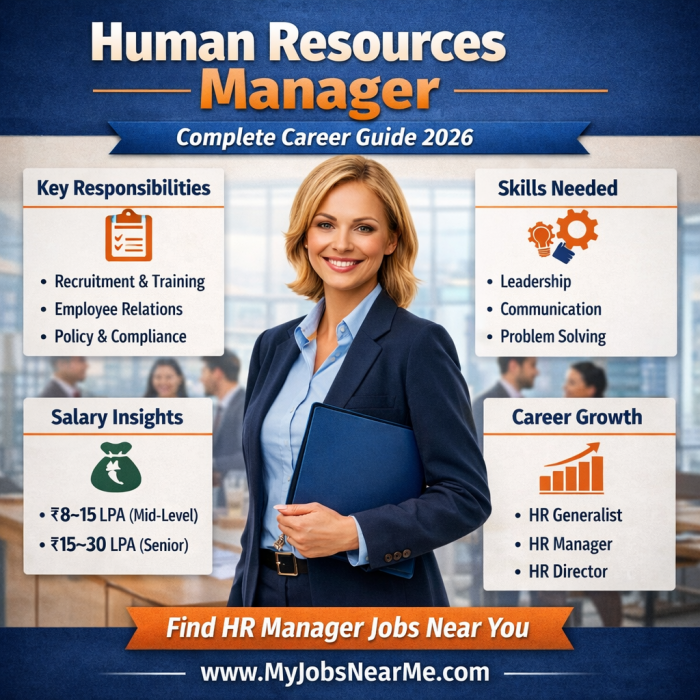
Human Resources Manager – Complete Career Guide (2026) A Human Resources Manager (HR Manager)  plays a critical role in shaping an organization’s workforce, culture, and overall success. From hiring the right talent to building a positive workplace environment, HR Managers are at the heart of every successful business. What is a Human Resources Manager? A Human Resources Manager is responsible for overseeing all aspects of employee management, including recruitment, training, performance, and workplace policies. They act as a bridge between employees and management, ensuring smooth communication and organizational growth. Key Responsibilities of an HR Manager 1. Recruitment & Hiring HR Managers manage the entire hiring process—from job postings to interviews and onboarding new employees. 2. Employee Training & Development They design training programs to improve employee skills and support career growth within the organization. 3. Performance Management HR Managers monitor employee performance, conduct appraisals, and provide feedback for improvement. 4. Employee Relations They handle workplace issues, resolve conflicts, and maintain a healthy work environment. 5. Policy Development & Compliance HR ensures company policies align with labour laws and organizational goals. 6. Compensation & Benefits Managing salaries, bonuses, and employee benefits is another key responsibility. Skills Required for HR Managers To succeed as an HR Manager, you need a mix of technical and soft skills: Strong communication & interpersonal skills Leadership and decision-making abilities Problem-solving & conflict resolution Knowledge of labour laws and HR policies Recruitment and talent management expertise Qualifications & Career Path Educational Requirements: Bachelor’s degree in HR, Business Administration, or related field MBA in HR (preferred for senior roles) Career Progression: HR Executive → HR Generalist → HR Manager → HR Director Most HR Manager roles require 3–7 years of experience in HR-related positions. Salary Expectations Entry-level HR Manager: ₹4–8 LPA (India) Mid-level: ₹8–15 LPA Senior HR Manager: ₹15–30+ LPA Salary varies based on company size, industry, and experience. Why Choose a Career in Human Resources? High demand across industries Opportunity to work with people and influence company culture Strong career growth and leadership roles Job stability and competitive salaries HR Managers are no longer just administrators—they are strategic leaders driving business success . Conclusion A career as a Human Resources Manager is both rewarding and impactful. If you enjoy working with people, solving problems, and shaping workplace culture, HR management offers excellent long-term opportunities. FAQs 1. What does an HR Manager do? An HR Manager handles hiring, training, employee relations, and company policies. 2. Is HR Manager a good career? Yes, it offers stability, growth, and leadership opportunities across industries. 3. What skills are required for HR? Communication, leadership, recruitment, and problem-solving skills are essential. 4. How long does it take to become an HR Manager? Typically 3–7 years of experience in HR roles. //
Jobs Near Me Find the Best Local and Online Jobs in 2026 Searching for jobs near me is one of the most effective ways to find employment today Whether you are looking for full time part time remote or entry level roles platforms like MyJobsNearMe.com make it easy to discover opportunities across the United States With thousands of listings across industries and cities job seekers can quickly connect with employers and apply in just a few clicks Why Jobs Near Me Is the Top Job Search Keyword The keyword jobs near me is popular because people want Location based job results Faster hiring opportunities Local companies hiring immediately Easy application process Modern job portals match candidates with relevant roles based on location skills and experience Top Job Categories Near You in 2026 Office and Administration Jobs Office assistant Receptionist Data entry operator Keywords office jobs near me admin jobs near me IT and Remote Jobs Software developer Digital marketing Remote support roles Keywords remote jobs near me IT jobs USA Customer Service and Sales Jobs Call center jobs Sales executive Retail associate Keywords customer service jobs near me sales jobs USA Construction and Engineering Jobs Site engineer Construction worker Technician Keywords construction jobs near me engineering jobs USA Warehouse and Delivery Jobs Warehouse associate Delivery driver Logistics assistant Keywords warehouse jobs near me delivery jobs USA How to Find the Best Jobs Near You Using MyJobsNearMe.com you can filter jobs by City such as New York Chicago Dallas Category such as IT Admin Sales Job type such as full time or part time The platform provides thousands of job listings making your job search simple and fast Tips to Get Hired Faster Apply to multiple jobs daily Customize your resume for each job Set job alerts Prepare for interviews Use trusted job platforms Jobs Near Me by Location Popular job locations include New York Chicago Dallas Los Angeles Houston These cities offer a wide range of opportunities across industries Why Use MyJobsNearMe.com Thousands of live job listings Covers all US states Easy search by location and category Fast application process Suitable for freshers and experienced candidates FAQs Jobs Near Me What does jobs near me mean It refers to job opportunities available in your local area based on your location How can I find jobs near me quickly Use job portals like MyJobsNearMe.com and search by location Are remote jobs available Yes many companies offer remote jobs and work from home opportunities Do I need experience to get a job Not always many entry level jobs are available for freshers Is it free to apply for jobs online Yes most job platforms allow free job applications //
There have been organizations taking up measures to cover the stress of employees while they are working remotely, during the coronavirus pandemic. But it really matters when you are in search of jobs with pressure carried on both mentally and physically. Few jobs involve a lot of balance while managing work, especially with the creative jobs. The covid-19 situation has proven that it is not easy during Job Search , as many think. You feel the real stress coming out when maintaining office and domestic needs at a place where you desire to stay most of the time- The Home. Interactions with the clients or internal teams over the phone, setting up virtual meetings, and finalizing critical projects include a great combined effort. This could be made comparatively easy when working at the office, while it may complicate things at times when working from home. Let’s look at all  4 issues while you perform Search for Jobs Near Me  and possible solutions, especially as the pandemic continues. Reduce causes for Burnout Many people who work from home may not directly get impacted instantly with the issues but it’s easy to spot during the pandemic, with enough time frames that it provided. One of the major signs is persistence which brings the exhaustion from burnout and that runs. Indeed it doesn’t go away quickly. Overcoming the below other issues can turn you ON better: Experiencing symptoms of depression Going through mood changes like sadness, irritability, or anger Feeling discouraged or apathetic about work Drinking more alcohol than normal, or drinking to cope Getting poor sleep, experiencing insomnia, or having trouble falling asleep Chest pain, increased illness, headaches, dizziness or fainting, heart palpitations, or gastrointestinal pain. Manage proper habits Eat healthy, exercise daily, sleep properly- these are not just sayings, but need to be implemented on a daily routine to stay fit and safe. Without energy and health, office work looks to be a burden. Manage all these habits to see a good delivery of results at work. Stay away from the phone at least 30 minutes before you go to bed. Maintain control Take a break when you get to relax, especially with the stress of being bearded for too long with Job Search . The break may last from hours to days, depending on the condition your body really needs. You can’t just work like a machine even when you are exhausted, while the machines do need some rest to run over perfectly.  Limitations are important Setting overloading search targets all through the time is not necessary, especially when you are away from home. Just search through the nearby jobs that you believe can be finished in desired timelines. Even with huge pay from the employer, none can put forth beyond the limits at work. Besides, health is more important.
You might be at a dark point when something’s wrong with your current job. But that doesn’t mean to take a shift. If yes, you have decided to move your career into another field, make sure you meet the below criteria. My Jobs Near Me  is making sure to help people in making wise decisions. Here are the 4 reasons that elevate your way of thinking as you make the bold decisions of switching careers. Seriousness of changing career People have a huge intimidation in every aspect of life as they start their career, family, and whatnot. But you are into the decision-making of changing your career and find jobs in something new including IT Jobs . So make sure you are beyond thinking all the below factors and any of them shouldn’t be a reason for transformation: Too much time spent for the same role Not given proper respect No interest in the subject or the work at a point in time A team that is not encouraging No progress or promotion A general need for change. These appear to be silly reasons once you make a shift and are unsuccessful in a new path. These reasons however re-iterate to the people who plan shifting to other companies.     Make an Action Plan Begin your action plan on what’s your primary goal and ideal timeline to work it out better. After all the groundwork, break it down into major milestones. Include your skills or the ones to acquire, things you need to wrap up in your current job, and people you need to meet. Also, have a key note on your personal things that you need to attend prior to making the shift. Assign yourself daily or weekly tasks if your career shift is into Engineering Jobs , so that you know what, exactly, you’ll be doing when you are on site. As you complete these tasks, you’ll also likely notice how small steps tend to have a snowball effect. Later, give both momentum and confidence that this is, in fact, a very real possibility, as you step in a new world of career.     Capability of moving out and bouncing in The real tension lies in perfection. You may or may not be a person who could adjust everything. And before all that the new position or role that you have dreamt of may leave you into night mares. It’s always risky moving into another career path for many as a lot change such as: Organizational skills Ability & fund-raising knowledge People skills Ideas and getting initiatives off the ground. You may need to adjust to all the above factors and additional issues if any. So it’s better to think a lot before making a change in your career.     Readiness to start from the scratch You are starting from zero in terms of work and you might also be asked to get trained. So, you are literally starting a new job. This might even defend your salary demands. Be happy with what you earn and remember to meet your domestic necessities, if you are married and having kids. So finally look into the possibilities and consequences of changing your career and make sure that is not messed up.